
The shell suit never actually went away; it just got stuck wearing the wrong reputation. For years, knowing how to style a retro shell suit has felt like a fashion minefield, a garment so loaded with cultural baggage that most people either avoided it entirely or leaned into the joke. That stops here.
You already know the feeling: you're drawn to the bold colour-blocking, the satisfying nylon sheen, the unmistakable energy of the silhouette, but the moment you picture yourself in one, the doubt creeps in. Will it look cheap? Will it read as a costume? Those concerns are completely valid, and they're exactly why most shell suit guides miss the mark entirely.
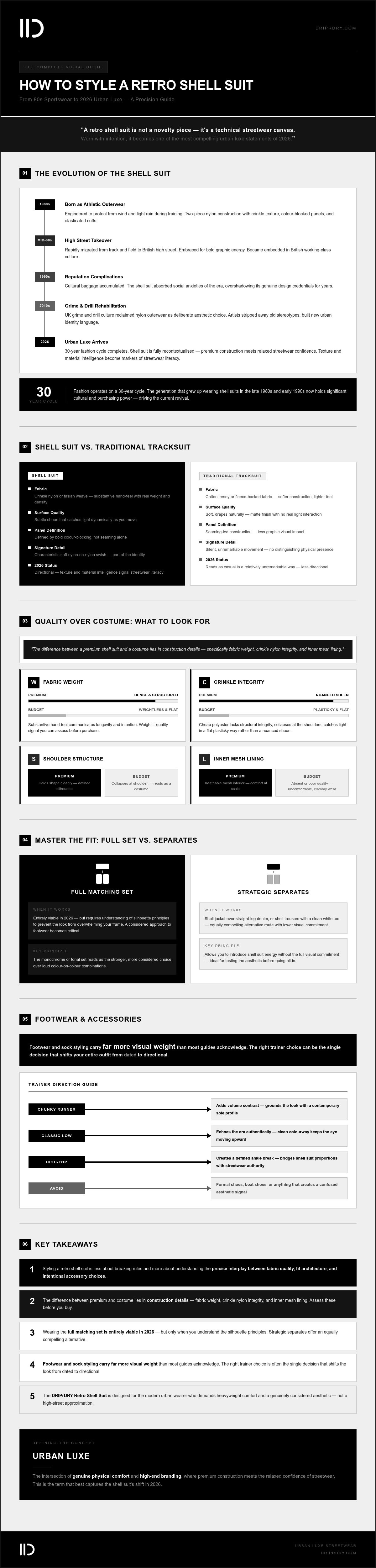
This guide is built around a single, non-negotiable principle: a retro shell suit is not a novelty piece. It's a technical streetwear canvas, and when it's constructed with genuine quality and worn with intention, it becomes one of the most compelling urban luxe statements you can make in 2026. What follows is a precise, considered breakdown of how to pair it, how to layer it, and how to carry it with the kind of quiet confidence that makes people ask where you got it rather than what you're dressed as.
Key Takeaways
- Knowing how to style a retro shell suit is less about breaking rules and more about understanding the precise interplay between fabric quality, fit architecture, and intentional accessory choices that elevate it from novelty to urban luxe.
- The difference between a premium shell suit and a costume lies in the construction details — specifically fabric weight, crinkle nylon integrity, and inner mesh lining — and this guide shows you exactly what to look for before you buy.
- Wearing the full matching set is entirely viable in 2026, but only when you understand the silhouette principles that prevent the look from overwhelming your frame; strategic separates offer an equally compelling alternative route.
- Footwear and sock styling carry far more visual weight than most guides acknowledge, and the right trainer choice can be the single decision that shifts your entire outfit from dated to directional.
- The DRIPrDRY Retro Shell Suit represents a considered approach to this silhouette, designed for the modern urban wearer who demands heavyweight comfort and a genuinely considered aesthetic rather than a high-street approximation.
The Evolution of the Shell Suit: From 80s Sportswear to 2026 Streetwear
Before you can fully understand how to style a retro shell suit with genuine authority, it helps to understand exactly what you're working with and why it carries the cultural weight that it does. The shell suit is, at its core, a two-piece tracksuit constructed from lightweight nylon-based fabrics, characterised by its distinctive crinkle texture, vibrant colour-blocked panels, elasticated cuffs and ankles, and a high-zip collar that became one of the most recognisable silhouettes of the late twentieth century. It wasn't born as a fashion statement; it arrived as functional athletic outerwear, engineered to protect the body from wind and light rain during training.
What happened next was entirely unplanned. By the mid-1980s, the shell suit had migrated from track and field into the high street with remarkable speed, adopted by a generation that valued its bold graphic energy as much as its practicality. Sportswear brands were producing them in increasingly vivid colourways, and the garment became embedded in British working-class culture in a way that few pieces of clothing ever achieve. That cultural intimacy is precisely why the reputation became complicated. The shell suit absorbed the anxieties of a particular social moment, and for years, that association overshadowed everything else about it.
Why Nostalgia is Trending in UK Streetwear
Fashion operates on roughly a thirty-year cycle, and the mathematics here are straightforward: the generation that grew up wearing shell suits in the late 1980s and early 1990s now holds significant cultural and purchasing power. But the revival isn't purely sentimental. UK grime and drill culture have played a decisive role in rehabilitating the nylon silhouette, reclaiming oversized technical outerwear as a deliberate aesthetic choice rather than a relic. Artists and their visual teams have recontextualised the shell suit within a broader language of urban identity, stripping away the old stereotypes and replacing them with something considerably more considered. Urban Luxe is the term that best captures this shift: it describes the intersection of genuine physical comfort and high-end branding, where premium construction meets the relaxed confidence of streetwear.
Shell Suit vs. Traditional Tracksuit: What's the Difference?
The distinction matters, and it's more than material-deep. A traditional tracksuit is built from cotton jersey or fleece-backed fabric; it's soft, it drapes, and it reads as casual in a relatively unremarkable way. A shell suit is built from crinkle nylon or taslan weave, and that choice of fabric changes everything about how the garment behaves and communicates. The surface has a subtle sheen that catches light differently depending on how you move. The panels are defined by colour rather than seaming alone. And then there's the sound: that characteristic soft swish of nylon against nylon, which is as much a part of the shell suit's identity as anything visual. These aren't incidental details; they're the precise qualities that make the silhouette so directional in 2026, when texture and material intelligence have become genuine markers of streetwear literacy.
Quality Over Costume: Identifying a Premium Retro Shell Suit
The single most important decision you'll make when learning how to style a retro shell suit happens before you've even thought about footwear or accessories: it happens at the point of purchase. The difference between a shell suit that reads as urban luxe and one that reads as a last-minute fancy dress choice is almost entirely determined by construction quality, and most guides never go near this conversation.
Start with fabric weight. A premium crinkle nylon shell suit has a substantive hand-feel; when you hold the jacket, there's a density to it that communicates longevity and intention. Cheap polyester alternatives feel almost weightless in a way that isn't a compliment. They lack structural integrity, they collapse at the shoulders, and they catch light in a flat, plasticky way rather than the nuanced sheen that makes quality nylon so visually compelling. Weight isn't just a comfort indicator; it's a quality signal you can assess before you've even tried the garment on.
The inner lining deserves equal attention. A breathable mesh lining serves two distinct purposes: it allows airflow during movement, making all-day wear genuinely comfortable rather than clammy, and it prevents the outer shell from clinging directly to your base layer, which preserves the silhouette's intended drape. If a shell suit has no lining, or a thin synthetic one that traps heat, it's been built to a price point rather than a performance standard.
Stitching quality becomes most visible at the panel seams. Multi-coloured shell suits rely on precise panel joining to make the colour-blocking look deliberate and graphic rather than approximate. Run your finger along the seam lines: the stitching should be tight, even, and completely flat against the fabric. Puckering, loose threads, or misaligned panels are immediate indicators of a garment that won't hold its shape after a few washes. Hardware matters too. Durable YKK-style zip mechanisms and metal-tipped drawstrings are small details that signal a brand's commitment to longevity over cost-cutting.
The 'Fancy Dress' Trap: What to Avoid
There are three immediate warning signs that a shell suit belongs in a costume shop rather than a considered wardrobe. First, printed-on colour panels rather than genuinely sewn, separate fabric pieces: this shortcut produces a flat, decal-like appearance that no amount of styling can rescue. Second, the phrase "one size fits all," which is simply incompatible with a garment where silhouette is everything. Third, an exaggerated, unshaped cut that creates a balloon-like volume around the torso and thighs, the visual signature of a disposable garment that was never designed to flatter a real body.
Modern Tailoring in Retro Designs
The 2026 interpretation of the shell suit silhouette is meaningfully different from its 1980s origin. Contemporary fits introduce a tapered leg that acknowledges the ankle rather than swamping it, and a jacket body that follows the torso without constricting it. Embroidery, applied with precision at the chest or sleeve, elevates the surface detail from print to craft, adding tactile depth that photography doesn't fully capture but the wearer always feels. This is precisely the philosophy that shapes the DRIPrDRY brand's approach to fabric integrity, where retro design language is reinterpreted through a commitment to heavyweight comfort and considered construction rather than surface-level nostalgia. Understanding how to style a retro shell suit well begins with owning one that was built to be worn seriously.
Master the Fit: Full Set vs. Strategic Separates
Wearing the full matching set is a statement of intent. Done correctly, it communicates a level of aesthetic confidence that separates the considered wearer from someone who simply threw on a tracksuit. Done carelessly, it overwhelms the frame and flattens the silhouette into a single undifferentiated block of colour. The difference lies almost entirely in how you manage proportion, and that conversation starts before you've even left the house.
The foundational principle when wearing a matched shell suit top and bottom is this: let the garment lead, and let everything underneath it recede. A slim-fitting, plain crew-neck tee worn beneath the jacket creates the contrast that the eye needs to read the silhouette as intentional rather than accidental. Specifically, layering over a Signature Drip T-Shirt achieves exactly this: the clean graphic of the tee is visible at the collar and cuff, creating a deliberate layering detail that reads as considered rather than lazy. Avoid anything with competing prints or heavy branding at this layer; the shell suit is the statement piece, and the base layer exists to support it.
Styling the Shell Jacket as a Standalone Piece
Separating the jacket from its matching trousers is one of the most versatile moves in the shell suit playbook, and it opens up considerably more styling territory than the full set. Worn over premium raw selvedge denim or slim-cut tailored trousers, the shell jacket creates a high-low tension that feels genuinely directional in 2026. The nylon sheen against matte fabric is a textural conversation, not a clash. For those based near the coast, there's also a thoroughly practical dimension: the shell jacket's wind-resistance makes it a functional layering piece for Shoreham's coastal conditions, where the sea breeze demands outerwear with genuine technical credentials rather than purely aesthetic ones.
The Bottom-Up Approach: Styling Shell Pants
Shell pants present a different set of considerations. Their tapered cut and elasticated ankle demand precision at the hem, and the 'cuff check' is non-negotiable: the trouser break should sit cleanly above the trainer's tongue, exposing a deliberate sliver of sock or ankle. Pairing shell pants with a heavyweight comfort hoodie grounds the look effectively, the hoodie's dense fabric providing a visual anchor that prevents the lighter nylon from reading as flimsy. The weight contrast between materials is the point.
On colour: the choice between neon retro colourways and blacked-out urban luxe palettes isn't simply aesthetic preference; it's a declaration about how you want the garment to read in context. Vibrant colour-blocking communicates energy and cultural fluency, while a monochrome shell suit in black or deep navy reads with a quieter authority that transitions more easily across different environments. Neither approach is more correct when you understand how to style a retro shell suit with genuine intention; the question is simply which version of the statement you want to make.
Footwear and Accessories: Completing the Urban Luxe Look
Most shell suit guides treat footwear as an afterthought. That's a significant miscalculation. The trainer you choose carries more visual authority than almost any other decision in this outfit, because it's the point where the nylon silhouette meets the ground, and that transition either reinforces the look's intentionality or quietly undermines it. Understanding how to style a retro shell suit properly means treating footwear as a primary design decision, not a finishing touch.
The two silhouettes that work with consistent reliability are chunky retro runners and clean terrace trainers. Chunky 'dad' shoes, think wide-toe-box runners with visible midsole architecture, echo the shell suit's own 1980s and 1990s design language without feeling like a costume. They share a visual era. Clean terrace trainers, the flat-soled, low-profile styles associated with British football culture, work from the opposite direction: their simplicity creates a grounding contrast against the suit's bold colour-blocking, letting the nylon do the talking while the shoe provides a quiet full stop.
The Best Trainers for Shell Suits
Colour coordination here follows a single, reliable principle: identify the most restrained accent panel in your shell suit and match your trainer to it, not to the dominant colour. If your suit leads with electric blue and carries white piping, a white trainer creates harmony without competition. This approach works regardless of your colourway. For those newer to the look, clean white trainers remain the most forgiving entry point: they pair with virtually any palette, they read as considered rather than try-hard, and they keep the eye moving upward toward the suit rather than anchoring it at the foot.
The Sock Question
The 2026 verdict on socks is unambiguous: a deliberate sliver of ribbed sock, visible between the tapered trouser cuff and the trainer's collar, is the correct choice. A crew-length sock in a neutral tone or a colour pulled from the suit's secondary palette signals precision. Tucking the trouser into the sock reads as unintentional rather than directional, and ankle socks that disappear entirely leave the transition between nylon and rubber looking unresolved.
Accessorising for the Shoreham Scene
Headwear demands restraint when the shell suit is already carrying significant visual weight. A minimalist beanie worn with a slight back-tilt keeps the proportions balanced without competing with the suit's colour story. The Drip Beanie works particularly well in Shoreham's coastal environment, where the wind makes headwear a practical necessity rather than a purely aesthetic one. A structured cap offers an alternative for warmer days, though the brim should be worn forward to maintain the look's clean geometry.
Cross-body bags serve a genuinely useful function beyond convenience: a compact bag worn across the chest or back breaks up large, uninterrupted blocks of colour, introducing a diagonal line that adds movement to the silhouette. Choose a minimal design in leather or technical nylon; anything heavily branded or oversized will compete with the suit rather than complement it.
On jewellery: gold chain against high-shine nylon is one of the most compelling textural conversations in contemporary streetwear. The warmth of gold against cool nylon sheen creates a contrast that reads as deliberately luxurious. Keep the weight proportional to the suit's scale, a medium-gauge chain worn outside the collar, and resist the temptation to layer multiple pieces. One considered chain carries more authority than three competing ones. Silver works equally well with monochrome or blacked-out shell suits, where the cool metal tone reinforces the look's quieter register.
Sunglasses, when the Shoreham light demands them, should echo the suit's era. Slim rectangular frames or slightly oversized square lenses from the late 1980s and early 1990s design vocabulary complete the aesthetic without tipping into parody. The key is proportion: frames that are too small read as mismatched, while those that are too large overwhelm the face and compete with the suit's own scale.
Every accessory decision in this look serves the same function: to signal that the shell suit was chosen deliberately, worn with intelligence, and finished with the same level of care that went into selecting it. Explore the DRIPrDRY urban luxe collection to find the shell suit that gives your accessories something genuinely worth framing.
The DRIPrDRY Retro Shell Suit: Elevating a Shoreham Classic
There's a meaningful difference between a brand that produces a shell suit and one that genuinely understands why the shell suit matters. DRIPrDRY sits firmly in the second category. Based in Shoreham-By-Sea, the brand approaches the retro silhouette not as a nostalgic exercise but as a considered design problem: how do you take a garment with this much cultural weight and build it for the way people actually live in 2026? The answer, as the DRIPrDRY Retro Shell Suit demonstrates, lies in refusing to separate quality from identity.
The brand's most distinctive design decision is the integration of Arabic calligraphy into its sportswear silhouettes. DRIPrDRY combines heritage Arabic script with 90s sportswear architecture, placing traditional calligraphic detail within the graphic language of crinkle nylon and colour-blocked panels. The result isn't a novelty fusion; it's a genuinely coherent aesthetic statement that positions the wearer within a broader conversation about cultural identity and urban expression. This is precisely the kind of considered detail that separates an independent label from a generic high-street approximation, and it's central to understanding how to style a retro shell suit as a piece with genuine meaning rather than surface-level nostalgia.
Caring for your nylon shell suit correctly is non-negotiable if you want the garment to hold its construction integrity over time. Follow these principles without compromise:
- Cold machine wash only, at 30°C maximum, to preserve the nylon's sheen and prevent fabric distortion at the panel seams.
- Never tumble dry. Heat degrades crinkle nylon's structural integrity and flattens the texture that defines the garment's visual character. Air dry flat or on a hanger.
- Turn the suit inside out before washing to protect embroidered or printed surface details from abrasion.
- Avoid fabric softener, which coats nylon fibres and progressively dulls the sheen that makes a premium shell suit so visually compelling.
- Store hanging rather than folded to prevent crease lines forming across the colour panels.
From Shoreham to the City: Versatility in Design
Shoreham-By-Sea has a coastal energy that demands clothing capable of genuine range. A morning walk along the River Adur requires wind-resistant technical outerwear; an evening in Brighton's independent venues demands something with considerably more visual authority. Whether you are catching a fresh set on Doubleclap Radio or heading out to a local club, the DRIPrDRY shell suit handles both transitions without compromise. Swap the chunky runner for a clean terrace trainer, introduce a gold chain at the collar, and the same garment that performed practically on the seafront reads as a deliberate urban luxe statement by nightfall. This is the 'Urban fashion Shoreham-By-Sea' connection in its most functional form: clothing that respects the specific demands of coastal life without sacrificing the aesthetic intelligence the wearer deserves.
Join the Drip: Building Your 2026 Wardrobe
The shell suit is the ideal entry point into the DRIPrDRY universe precisely because it establishes the aesthetic framework that every other piece in the collection reinforces. Layer the shell jacket over the Signature Drip T-Shirt for a look that balances technical outerwear with graphic precision. Pair the shell pants with the heavyweight comfort hoodie on days when the temperature demands more insulation. Each combination builds on the same foundational logic: heavyweight comfort materials, considered construction, and a design language that holds its own in any urban environment. The collection isn't a set of individual pieces; it's a coherent wardrobe built around a single, uncompromising standard.
Knowing how to style a retro shell suit well ultimately comes down to starting with a garment that was built to be worn seriously. Shop the latest DRIPrDRY Retro Shell Suit collection here and find the piece that makes every other styling decision considerably easier.
Your 2026 Shell Suit Era Starts Now
Knowing how to style a retro shell suit well comes down to three decisions made in the right order: start with quality construction, understand your silhouette options, and let your accessories do precise supporting work rather than competing for attention. Get those three things right and the rest follows naturally.
What separates a genuinely compelling shell suit look from a forgettable one isn't confidence alone; it's having a garment that earns that confidence before you've even stepped outside. DRIPrDRY's Retro Shell Suit is built on exactly that principle: an independent Shoreham-By-Sea brand committed to premium heavyweight materials and signature Arabic Drip designs that position this silhouette firmly within a considered, culturally fluent aesthetic rather than surface-level nostalgia.
The shell suit has earned its place in 2026 streetwear, and you now have everything you need to wear it with genuine authority. Secure your Urban Luxe look with the DRIPrDRY Retro Shell Suit and build an outfit that people remember for exactly the right reasons.
Frequently Asked Questions About Styling a Retro Shell Suit
Are shell suits still in style in 2026?
Shell suits are genuinely directional in 2026, not simply tolerated as a nostalgic throwback. UK grime and drill culture have done considerable work rehabilitating the nylon silhouette over the past several years, repositioning it within a broader urban luxe aesthetic that values technical fabric intelligence alongside visual confidence. The key distinction is construction quality: a premium crinkle nylon shell suit reads as a considered streetwear statement, while a cheap polyester alternative still carries the old costume-shop associations.
How do I wash a retro shell suit without ruining the nylon?
Cold machine wash at 30°C maximum, turned inside out, with no fabric softener. Fabric softener coats nylon fibres progressively and dulls the surface sheen that defines a premium shell suit's visual character. Never tumble dry; heat degrades crinkle nylon's structural integrity and flattens the texture permanently. Air dry flat or on a hanger, and store it hanging rather than folded to prevent crease lines forming across the colour panels.
Can I wear a shell suit to a casual dinner?
Yes, provided you approach the transition deliberately. Swap chunky retro runners for clean terrace trainers, introduce a single gold chain worn outside the collar, and ensure your base layer is a slim-fitting, plain tee rather than anything with competing graphics. A monochrome or blacked-out shell suit handles this transition most easily, carrying a quieter authority that reads appropriately across a wider range of environments without requiring any additional pieces.
What is the best footwear to wear with a shell suit?
Two silhouettes work with consistent reliability: chunky retro runners with visible midsole architecture, which echo the shell suit's own design era, and clean flat-soled terrace trainers, which ground the look through contrast rather than echo. For colour coordination, match your trainer to the most restrained accent panel in your suit rather than the dominant colour. If you're newer to the look, clean white trainers remain the most forgiving entry point and pair with virtually any shell suit palette.
Is a shell suit better than a cotton tracksuit?
They serve genuinely different purposes, so "better" depends entirely on context. A cotton tracksuit drapes softly and reads as casual in a relatively unremarkable way. A shell suit's crinkle nylon construction carries a surface sheen, defined colour-blocked panels, and wind-resistant technical credentials that a cotton alternative simply can't replicate. For urban environments where visual authority and light weather-resistance both matter, a premium shell suit offers a considerably more considered proposition.
How should a shell suit fit? Should I go oversized?
The 2026 interpretation favours a contemporary tapered fit rather than the unshaped balloon silhouette of the original 1980s garment. The jacket body should follow the torso without constricting it, and the trouser leg should taper cleanly toward the ankle, with the hem sitting above the trainer's tongue to expose a deliberate sliver of sock. Genuine oversizing collapses the silhouette's architecture and is one of the clearest signals that a shell suit wasn't designed to be worn seriously.
What is the difference between a vintage and a retro shell suit?
A vintage shell suit is an original garment from the 1980s or early 1990s, carrying the construction limitations of that era: thinner fabrics, less precise panel seaming, and sizing that rarely translates well to contemporary proportions. A retro shell suit is a modern garment that draws on that design language while applying current construction standards, including heavier fabric weight, breathable mesh lining, and a tapered fit architecture. Knowing how to style a retro shell suit well is considerably more achievable when you're working with a piece built for how bodies and wardrobes actually function today.
Can I mix shell suit jackets with jeans?
This is one of the most versatile moves available within the shell suit playbook. Worn over premium raw selvedge denim or slim-cut trousers, the shell jacket creates a high-low textural tension that feels genuinely directional: the nylon sheen against matte fabric is a deliberate contrast, not a clash. Choose a shell jacket with a restrained colourway if you're pairing it with denim for the first time, since a single bold accent colour against a neutral jean reads as considered rather than overwhelming.